
Why Calisthenics Should Be About Control, Not Ego

If you've spent any time at a calisthenics park (or even in a functional fitness gym), you've probably seen this scenario:
Someone makes a big fuss of a muscle-up attempt. There's a huge swing, a big kick, but they don't quite make it.
A few minutes later, someone else walks over, starts from a dead hang, and does five slow pull-ups that all look the same. No drama, just amazing control.
This is what calisthenics has always been about. Not chasing the hardest movement you can (almost) do, but owning the movement you’re already capable of.
It's easy to think everyone is landing planches and handstand push-ups. Believe me, they’re really not. Social media doesn’t show the failed reps, the unflashy training sessions, the drills, and the basics.
Calisthenics doesn't care about the algorithm. And your body responds to quality, consistency, and good old progressive overload.
What does control in calisthenics mean?
Control isn't moving slowly for the sake of it, it’s being able to place your body where you want it and move it through time and space.
Think about a pull-up.
Can you pause in a dead hang?
Can you pull without kipping?
Can you stop at the top instead of throwing your chin over the bar?
Can you lower yourself under control?
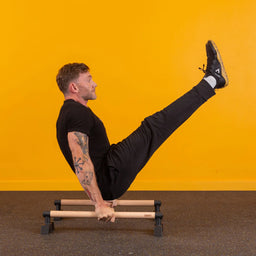
The same sort of thing applies to dips, push-ups, handstands, L-sits, and every other calisthenics movement.
The goal isn't just to complete the exercise and it certainly isn’t to muscle your way through a horrible rep just to say you did it.
The goal is to own every part of it, understand what your body is doing, and be able to replicate it.

Control exposes your training level
One of the reasons I admire calisthenics so much is that it's honest. Swinging and kipping movements can hide weaknesses or technique failures.
Once you slow the movement down, you’ll find out whether your grip is strong enough, your shoulders are stable enough, or your core is doing its job.
It can be frustrating, but it’s also why you’ll improve quicker once you stop trying to hide from those weak points.
How do good calisthenics athletes train
Watch experienced calisthenics athletes during a normal training session and you’ll notice that the majority of their session isn’t flashy movements or even the skill itself.
It’s drills, foundational work, and the basics that underpin every other calisthenics movement. They will also do mobility work, core work, and accessory strength work.
It's not the exciting answer, but it's what keeps athletes progressing year after year instead of picking up shoulder or elbow problems every few months.
5 ways to build more control into your training
Pause at the hardest point
Whether it's the bottom of a dip, the top of a pull-up, or the middle of an L-sit, pause for one second before moving again.
Slow the lowering phase
Anyone can drop out of a movement. Try taking three seconds to lower yourself on every pull-up, dip, or push-up. You'll quickly find out where your weak points are.
Leave a rep in the tank
Instead of squeezing out one sub-par final rep, stop while your technique is still solid.
Own your start and finish positions
Every rep should start and end in a position you can control. Start every pull-up from a dead hang. Finish every dip with locked elbows. Return to a proper hollow body before your next leg raise.
Move on when it looks effortless
Just because you can attempt the next variation doesn't mean you should. Own the basics first, it will make everything else feel easier.
Try the Gravity Fitness control test
Pick one movement you’ve already mastered.
Challenge yourself to do 5 reps:
-
starting from the correct position every time
-
pausing for one second at the hardest point
-
lowering under control
-
keeping the same technique on every rep
-
finishing without swinging or rushing
If you suddenly lose 2-3 reps, don't worry. That's a sign that you’ve tested your strength through the whole range, and might give you an idea of which part of the movement to work on.
There’s no finish line with calisthenics, so there’s no rush to complete every movement. You could spend a lifetime dedicating yourself to this style of training and still have goals to achieve.
So next time you're tempted to rush a progression, ask yourself if you really own the movement or if you’re just getting away with it. Because in calisthenics, control isn’t a nice extra – it’s the whole point.