
Athlete Interview: Joe Flinders

GRAVITY FITNESS:
Hi Joe, thanks for talking to us. Can you start by introducing yourself?
Joe Flinders:
I’m a calisthenics coach from Manchester.
Online I coach skills (hand balancing, calisthenics, and mobility training) and aesthetics, and I coach locally too, including Upside Down Club in Manchester.
I don’t compete in calisthenics but I do hand balancing events at expos on the international scene.
GF: How did you get into calisthenics?
JF:
I was introduced to yoga as part of my previous media role – before that I’d done nothing at all!
I really enjoyed it and wanted to achieve all the things I was seeing people do.
I knew calisthenics and yoga go hand-in-hand – calisthenics is the more methodical cousin of yoga. They’re both body movements and mechanics with the principles of strength and conditioning.
Around that time, a local calisthenics gym was opening and they asked me to be an ambassador.
Then in lockdown I realised I wanted to get out of the media world and I retrained as a PT so I could programme for myself. I fell in love with it and never looked back!
GF: What's a typical training week for you?
JF:
My typical training week at the moment is a bit different because I’ve just done a Hyrox.
Calisthenics changed my life and gave me a thirst for wanting to understand more – including the benefits of regular cardio.
My week includes a weekly cardio session, usually in a group environment like a Hyrox training class.
I like to get a yoga class in for exposure to end range of motion and flexibility.
Then at least 3 resistance sessions a week based around the skills I’m gunning for in – there’s always an objective and my strength work is always through a calisthenics and mobility lens
GF: Take us through a day in the life, including training and nutrition
JF:
I get up at 5am and keep the first hour of my day for me.
Then I start with check-ins with online clients, and train any face-to-face clients in the.
I take a lunchtime class a few days a week where I need to bring the energy for a group of people who are upside down!
The afternoon is for business development, social content, looking at ways I can better serve my clients.
I don’t have a lot of time for food prep so I use a delivery company called Nutritionist MCR.
I’m done by 4pm so I can train myself, walk my dogs, and look after recovery with sauna and ice bath.
I’m usually in bed by 9pm.
GF: How do you balance strength, skills, and recovery in training?
JF:
Calisthenics practitioners need to tick a lot of boxes in training, so I’ll pick multi-objective movements and active mobility drills that deepen range of motion and strength through length.
For example, I’m working on split to handstand press. For this I need my hamstring strong at full length, so I’ll do Jefferson curls Zurcher variation.
I like being inventive to get a lot done!
My non-negotiables are a passive/dynamic warm up and conditioning for the core and shoulders.
My main session is 2-4 movement patterns for skills, followed by strength work under fatigue.
GF: What's the worst mistake you've made or biggest lesson you've learned?
JF:
The biggest lesson I learned was a bit of a lightbulb moment. In calisthenics, the shoulder position should always oppose gravity – whether that's by protraction, retraction, elevation, or depression.
GF: What are 3 non-negotiable habits you'll always do all year round
JF:
Passive stretching outside of sessions – this will make the biggest difference to your mobility.
We spend 23 hours of the day with our muscles not under load – you bet I’m stretching my hamstrings at night watching TV.
Deload – you can’t keep going and going, if you don’t deload you are leaving gains on the table.
A 12 week block works best for me – then a full rest week or bring the load down to 50%.
Get used to the idea of filming yourself - it gives you a direct progress record, you’ll learn how to be your own feedback loop, and you’ll build your knowledge base.
GF: What are your 3 top tips for getting started in calisthenics?
JF:
If you have standard gym training knowledge, look at calisthenics through that lens.
Train pull, push, and don’t neglect lower body.
Some skills are going to take time, so pick some easy wins so you don’t get discouraged along the way.
Don’t neglect strength work – train skills first then supplement that with the supporting sets and reps of strength movements.
GF: What do you think are most under-rated and over-rated calisthenics exercises?
JF:
3 calisthenics exercises that I think deserve the hype are skin the cat (your shoulder is a ball and socket, so train it as such), pseudo planche push ups (it will teach you straight arm strength, bent arm strength, shoulder loading, deep wrist flexion), and seated straddle leg raises (multidirectional hip flexor strength, glute activation, and fine motor movement).
GF: What's the biggest myth in calisthenics?
JF:
The myth I hear most is you need to be flexible before you start calisthenics.
You can train mobility using progressive overload – your body will adapt and you can achieve range of motion and control.
If you want to improve mobility, calisthenics is a great way to do it.
If you tether your mobility goals to calisthenics skills, you will see yourself getting better and it’s fun along the way.
GF: Thanks Joe! What are your goals for 2026?
JF:
They’re are all upside down goals!
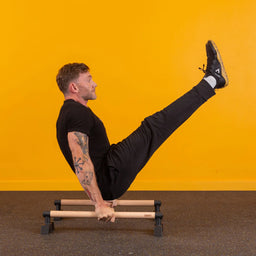
I want a handstand flag on the Gravity parallettes – it can look really beautiful.
For my bent arm skill I want nose to floor parallel bar handstand push ups on the Gravity Medium Parallettes.
A longer term goal is one-arm handstand.
In business, I’m reducing my number of clients so I can give a deeper service and I’m working hard to build the community around my Upside Down Club which meets every 2 weeks on a Saturday morning
Find Joe on socials and show him some love!