
Kaizen and Calisthenics: Why the Warrior's Path Is Paved With Small Steps


There's a temptation, one that almost every athlete falls for, to chase the destination instead of walk the road. You've seen the transformation posts, the before-and-after reels, the athlete holding their first muscle-up like a trophy. The goal burns bright, and suddenly everything in between feels like delay. But what if the "in between" is the point?
This is exactly what an ancient Japanese philosophy called Kaizen has been quietly teaching warriors, craftsmen, and athletes for centuries. And when you apply it to calisthenics training, it doesn't just change how you train, it changes how you think.

What Is Kaizen? The Philosophy of Continuous Improvement
The word Kaizen (改善) is Japanese for "change for the better", broken into kai (change) and zen (good). It's a philosophy rooted in the idea that lasting excellence is not the product of sudden, dramatic leaps, but of consistent, incremental improvement over time.
Kaizen was formalised as a business and manufacturing philosophy in post-war Japan, most notably through Toyota's production system. But its roots run far deeper — into the samurai code, into Zen Buddhist practice, into the very fabric of Japanese culture. The warrior who sharpens his sword every day does not do so because the blade is dull. He does so because the discipline of the act shapes the warrior as much as the weapon.
The core tenets of Kaizen are simple:
1. Progress over perfection. Don't wait until conditions are ideal. Start now, improve daily.
2. Process over outcome. Trust the system. The results take care of themselves.
3. Patience as strength. Rushing is a form of weakness. The warrior who cannot wait cannot endure.
4. Reflection and adaptation. Regularly assess what's working and refine it. Never stagnate.
For athletes building an aesthetic, powerful body through calisthenics, these principles aren't just motivational, they're a blueprint.
Why Calisthenics Is the Perfect Vehicle for Kaizen
Calisthenics is, at its essence, a practice of mastery. Unlike weight-based training where progression is often measured in plates added to a bar, bodyweight training demands that you become the weight, that you learn to control, leverage, and express your own body with complete precision.
You cannot fake a planche. You cannot borrow a muscle-up. Every skill, every movement, every hold is earned through accumulated practice. This is Kaizen in physical form.
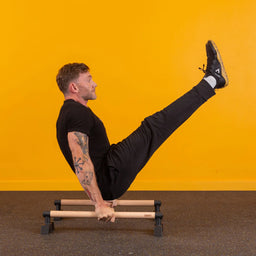
Consider the journey of a beginner picking up a pair of parallettes for the first time. Those two parallel bars represent a universe of progressive movement, from basic L-sits and push-up variations, all the way to advanced handstand presses and planche progressions. Nobody lands a planche on day one. But with Kaizen thinking, day one doesn't need to lead to a planche. It needs to lead, simply, to day two.
Each session builds neural pathways. Each rep refines motor patterns. Each week you're slightly stronger, slightly more controlled, slightly more you. That is the Kaizen way.
The Trap of Chasing Results Too Fast
Modern fitness culture has a problem with immediacy. Twelve-week transformations. Ninety-day challenges. Six-week shreds. The message is clear: results should be fast, and if they're not, something is wrong.
This mindset does enormous damage to athletes, especially those training calisthenics for an aesthetic body.
Here's what actually happens when you rush:
1. Technique breaks down. Calisthenics rewards precision. If you're loading movements you haven't earned, compensations creep in. Improperly loaded shoulder joints, hyperextended elbows, collapsed core positions, these don't just limit your progress, they end careers.
2. The plateau hits harder. Athletes who rush through foundational work tend to stall spectacularly later on. The foundations weren't built solidly enough to support the next level of skill. And the frustration of that stall often sends them spiralling back to square one, or out of the sport entirely.
3. You miss the aesthetics you're actually chasing. Here's the irony: the lean, powerful, deeply athletic physique that calisthenics builds is a byproduct of skilled movement. Athletes who train for mastery, who drill bodyweight rows, push-up progressions, dip variations, and hanging work consistently over months and years, develop a musculature that no shortcut can replicate. The separation in the delts, the carved lines of the back, the visible athleticism in the way they simply move: all of it comes from accumulated, patient skill work.
Applying Kaizen to Your Calisthenics Training
So how do you practically bring Kaizen into your training? Here's how the philosophy translates into sessions, weeks, and months.
1. Master the Basics Before Chasing the Advanced
In Kaizen, you don't skip steps. You refine what you already have until it's excellent, and then, and only then, do you move forward.
In calisthenics, this means building a bulletproof foundation: perfect push-ups before dips, dead hangs before pull-ups, hollow body holds before hanging leg raises. It means treating a basic movement not as something to graduate from but as something to graduate through.
Parallettes are a masterclass in this principle. The same piece of equipment that hosts a complete beginner's first supported L-sit also hosts an elite athlete's planche push-up. The tool doesn't change, your mastery does. Rather than rushing to the next parallette skill, focus on owning the current one: hit it for more reps, with cleaner lines, with less effort, from more varied positions. That's Kaizen.
2. Use Progressive Overload, Not Random Intensity
Kaizen is systematic. It doesn't believe in random bursts of effort followed by rest. It believes in steady, trackable progress.
For calisthenics athletes, this means keeping a training journal. Note your reps, your holds, your positions, your feel. When you can hit a movement cleanly for a given number of reps, you progress to the next variation. Not because you're bored, because you've earned it.
Resistance bands are a powerful Kaizen tool in this regard. Used intelligently, they allow you to load and unload movements in a way that creates genuine, trackable progression. Assisted pull-ups with a heavy resistance band give way to a medium band, then a light band, then unassisted reps. That linear, measurable reduction in assistance is Kaizen, visible, daily improvement that compounds over time.
The same principle applies going the other way: resistance bands can add load to push-ups, dips, and rows once bodyweight alone isn't sufficient stimulus. This means you're never stuck. There's always a next step. Always a kai, a change for the zen, good.
3. Train Consistently, Not Heroically
The warrior who trains for thirty minutes every day will, over a year, have trained for more than 180 hours. The warrior who trains heroically for three hours, burns out, and misses a month will have trained far less, and far less effectively.
Kaizen honours the small session. The twenty-minute morning movement practice. The parallette work in your living room between calls. The band pull-aparts before bed. These don't feel like training in the traditional sense, they feel like practice. And practice, done consistently, is where transformation actually lives.
4. Embrace the Plateau as Part of the Path
Every calisthenics athlete will hit plateaus. This is not failure. In Kaizen philosophy, a plateau is a signal, an invitation to reflect, assess, and adapt. Ask:
- Am I sleeping and recovering enough?
- Is my nutrition supporting my training demands?
- Am I moving through progressions too quickly, or staying on one variation too long?
- Is there a mobility limitation upstream of the movement I'm working on?
The warrior doesn't curse the river for not flowing faster. He studies the rocks and redirects his path.
5. Find Meaning in the Movement Itself
Perhaps the deepest teaching of Kaizen, and the one most relevant to training for an aesthetic body, is this: the process must be its own reward.
You will spend far more time training than you will spend displaying the results of your training. If your enjoyment is conditional on the outcome, you will spend most of your athletic life in a state of frustration. But if you fall in love with the training itself — with the feeling of a clean handstand hold, the pop of a well-executed muscle-up, the quiet satisfaction of a planche progression held two seconds longer than last week — then every session becomes a victory.
That is the warrior's path. Not the destination, but the discipline.
The Aesthetic Payoff of Patience
Let's be honest about the physical results too, because they are extraordinary.
Athletes who commit to long-term calisthenics training, applying Kaizen principles consistently over 12, 24, 36 months, develop a body that is visibly different from the product of any quick-fix programme. The physique is dense but lean, powerful but mobile. The shoulders carry a three-dimensional roundness that comes from pressing, supporting, and stabilising bodyweight across dozens of planes of movement. The back is wide and detailed, built through years of pulling and rowing. The core is not simply flat, it is functional, capable of expressing force in every direction.
This is the body that parallette training sculpts through planche work and L-sit progressions. This is the body that resistance band training conditions through pull-apart sequences, face pulls, and banded push movements. This is the body that emerges not from a sprint, but from a long, patient, Kaizen-guided journey.
And perhaps more importantly: it's a body you trust. You earned every inch of it. You know exactly what it can do because you built it rep by rep, session by session, day by day.

The Gravity Fitness Approach: Warrior Mentality, Kaizen Practice
At Gravity Fitness, we've always believed that the warrior mentality isn't about aggression or urgency. It's about commitment. It's about showing up when it's hard, progressing when it's subtle, and staying the course when results aren't yet visible.
Our equipment, from our parallettes to our resistance bands, is designed for athletes who are in it for the long game. Tools built to grow with you, to meet you at your level today and challenge you at your level tomorrow.
If you're beginning your calisthenics journey, Kaizen tells you this: start where you are, with what you have. Do a little more than yesterday. Come back tomorrow. That is everything.
If you're an experienced athlete, Kaizen tells you something subtler but equally important: there is always more depth to find. There are always cleaner lines, steadier holds, more effortless expressions of movement available to you. The journey doesn't end. It only deepens.
Change Your Mind, Change Your Body
Kaizen is not a training programme. It is a way of seeing. When you adopt it, you stop measuring your progress against some imagined ideal and start measuring it against yesterday's version of yourself. And that, the daily practice of becoming slightly better, is the only race worth running.
Pick up your parallettes. Grab your resistance bands. Show up today. And then show up again tomorrow.
The warrior path is long. That's precisely what makes it worth walking.
Ready to begin your Kaizen calisthenics journey? Explore Gravity Fitness's full range of calisthenics equipment — engineered for athletes who train for life.
Shop Parallettes | Shop Resistance Bands | Explore All Equipment


Gravity Fitness Medium Pro Hybrid Parallettes

Gravity Fitness XL Parallettes/barreaux réglables