
The Best Calisthenics Starter Kit for Your Home Gym

If you have ever asked me what to actually buy when you are starting out with calisthenics at home, you already know my answer is something like: less than you think, but choose wisely. I have had this conversation in the gym, in the car park, over DMs, and honestly it never gets old. So here it is in full, the definitive guide to building a calisthenics home gym in 2026, from someone who has tried almost everything and kept only what works.
The beauty of calisthenics is that you do not need a room full of equipment. What you need is the right kit, chosen to complement each other and grow with you over time. Let us walk through exactly that.
Why a Home Calisthenics Setup Makes Sense in 2026
Commercial gyms are great, but they were not built for calisthenics. The pull-up bars are often fixed at one height, the dip stations are crowded, and good luck finding a pair of parallettes in most of them. Building your own setup at home means you train on your terms, progress at your pace, and invest in kit that will genuinely last.
The good news is you do not need much space and you do not need to spend a fortune. A focused, well-chosen calisthenics equipment bundle will take you from your first pull-up all the way to advanced ring work and handstands.
The Foundation: A Pull-Up Bar or Gymnastic Rings
Let us start with the non-negotiable. Horizontal pulling is one of the fundamental movement patterns your body needs, and you cannot train it properly without something to hang from. You have two main options here and they suit slightly different setups.
Pull-up bars are the straightforward choice. If you have a doorframe, a wall, or a bit of floor space, you can have a bar up and ready in minutes. I recommend the Universal Door Pull-Up Bar for anyone renting or short on space. It requires no drilling, fits most standard door frames, and gets you doing pull-ups, chin-ups, and hanging core work immediately. If you do have the space and want something more permanent and versatile, the Portable Pull-Up Rack is genuinely one of the most popular pieces of kit we sell, and for good reason. It is freestanding, sturdy, and gives you room to kip, dip, and hang without worrying about doorframe clearance.
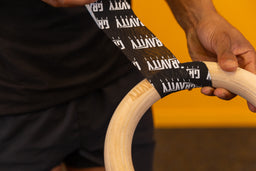
Gymnastic rings are arguably the more exciting option and, in my opinion, the smarter long-term investment. Rings are unstable by nature, which means every exercise demands more stabilisation and recruits more muscle than the bar equivalent. Pull-ups, rows, dips, push-ups, and eventually muscle-ups and iron crosses all live on the rings. Our wooden gymnastic rings are one of our best sellers because wood feels better in the hand than plastic, gives you a solid grip, and the straps adjust easily from low rows to full overhead hanging.
My honest take: if space allows it, get both eventually. But if you are picking one to start, go with the door bar or portable rack for pure pull-up training, or the rings if you want more variety from day one.
The Second Essential: Parallettes
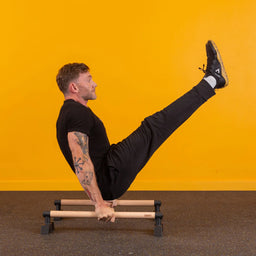
If rings are the king of upper body pulling, parallettes are the king of pushing, pressing, and handstand work. A good set of parallettes transforms your push-up game, unlocks L-sits and tuck planche progressions, and gives you the platform to work towards handstand push-ups and ring dip transfers.
Pair parallettes with your pull-up bar or rings and you have already covered every major upper body movement pattern: pulling, pushing, and pressing. That is a serious home gym right there.

Add Resistance Bands: The Smartest Low-Cost Addition
Resistance bands are one of those things that seem optional until you actually start using them, and then you wonder how you trained without them. They have two main roles in calisthenics and both are genuinely valuable.
First, they are the best tool for assisted pull-up and dip progressions. If you are working towards your first pull-up, looping a band over the bar and kneeling in it removes a portion of your bodyweight and lets you build the strength pattern correctly. It is far more effective than jumping and negatives alone.
Second, bands are excellent for adding resistance to bodyweight movements, warming up the shoulders and hips, and mobility work. A set of four resistance bands gives you a full range of assistance and resistance levels so you can match the band to the movement and your current ability.
They take up almost no space, travel brilliantly, and cost a fraction of any other piece of equipment. Bands are genuinely the most versatile thing in my kit bag.
Level Up with a Weighted Vest
Once you can comfortably do ten or more pull-ups and push-ups with good form, adding load is the natural next step. You could do more reps, but there is a limit to how much time under tension you can accumulate with bodyweight alone at a certain strength level. A weighted vest solves that neatly.
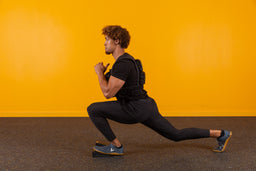
A vest sits evenly over your torso and lets you apply progressive overload to every bodyweight exercise without changing the movement pattern. Pull-ups, dips, push-ups, ring work, parallette pressing: all of them get harder in exactly the right way. Our 10kg, 20kg, and 30kg weighted vests are designed specifically for calisthenics training, meaning they do not restrict range of motion and stay in place under load.
I tend to recommend starting with 10kg and building from there. The jump from bodyweight to even 5kg added is significant at first, and training smart beats training heavy every time.
The Best Starter Bundles for Your Home Gym
If you are reading this and thinking you want to just get everything sorted in one go, that is exactly what our bundles are designed for. We have put together combinations of our best kit specifically for people starting out, scaling up, or building a complete home setup.
• Get Started Calisthenics Bundle: the ideal first purchase, combining the core pulling and pressing tools you need from day one.
• Get Started Parallettes Bundle: focused on parallette-based training with supporting accessories.
• Get Started Gymnastic Rings Bundle: perfect if rings are your starting point, giving you everything needed to get moving immediately.
• Ultimate Calisthenics Bundle: the full picture, for anyone who wants to build a serious home gym in one go.
• Small Space Calisthenics Bundle: designed for flats, small rooms, or anyone without a dedicated gym space.
Bundles work out cheaper than buying individually, and they have been put together by people who actually train with this kit every day. There is no filler in there.
A Quick Note on Space and Setup
One of the most common things I hear is that someone does not have space for a home gym. The setup I have described above fits into an area roughly the size of a yoga mat plus a couple of feet of height clearance. The portable rack folds down. The rings pack into a bag. The parallettes stack. The bands fit in a drawer.
You do not need a garage. You need about two metres of clear floor and somewhere to hang or mount a bar. That is genuinely it.
Final Thoughts
The best home calisthenics kit is not the most expensive or the most extensive. It is the stuff that matches where you are right now, keeps you progressing, and stays out of the way until you need it. A pull-up bar or rings, a set of parallettes, some bands, and eventually a weighted vest: that is your entire toolkit from beginner to advanced.
If you want a head start, browse the equipment bundles and pick the one that fits your budget and your space. And if you are unsure which direction to go, drop us a message. This is genuinely what we are here for.
Train well.